
What's Your Moral?
Every persuasive story needs one.

Screenwriters say that nearly every movie has an A story and a B story.
The A story is about the action, the fun stuff. This usually revolves around what the hero wants, what she’s trying to achieve, and the obstacles in her way.
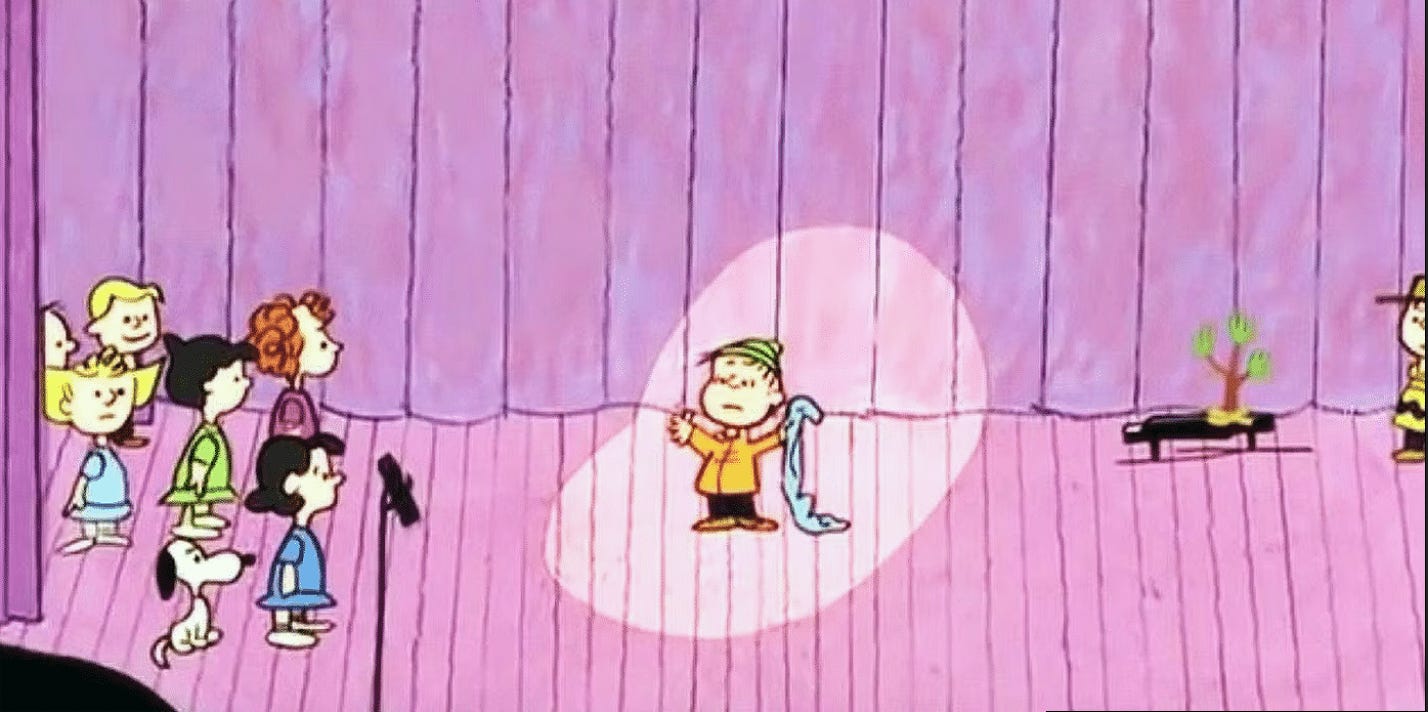
In A Charlie Brown Christmas (a classic!), Charlie founds himself depressed. The holidays aren’t ringing his jingle bells. Following the advice of his psychiatrist friend Lucy, Charlie gets involved with the Christmas play and finds himself responsible for getting a Christmas tree. Which leads to ridicule, without parents lawyering up.
The B story is the meatier line, guiding the hero’s transformation. Linus, the wisest thumb-sucking human ever, offers the true meaning of the season. The moral is clear: Christmas is about “tidings of great joy,” not the tinsel.
Every good story that persuades has its A and B sides.
Nike A side: Scenes of athletes performing amazing feats while wearing sneakers.
Nike B side: Just Do It.
Implied moral: Success comes from unhesitating commitment.
Apple Computer A side: Cool machine running desktop publishing and games.
Apple Computer B side: Think Different.
Implied moral: Buy an expensive microcomputer and become an artistic violator of grammatical rules.
Or take the Aesop fable, “The Ant and the Grasshopper”:
Aesop A side: Joyful Ant lives for the now until he runs up a federal deficit while being judged by Grasshopper.
Aesop B side: The Grasshopper work ethic prepares one for a hazardous future.
Decidedly un-American moral: “Work before play.”
A story can help you get buy-in for any product, idea, or point of view. But first you must establish your A and B stories and your moral. The A story is the fun stuff. Boy meets girl. Man hilariously screws up (see below). Child triumphs over disease/circumstances/negativity.
The B story often appears as a supporting actor, a Linus or Grasshopper who can state the moral outright or simply live it.
I believe that even a story not intended for persuasion works best with a moral behind it—stated or otherwise.
For illustration, here’s a piece I wrote for BICYCLING magazine (brilliantly edited by Steve Madden) back when I ran a group of outdoor magazines in 2002. It’s about how I stole the ride of the Michael Jordan of mountain biking. Can you spot the moral? I can name several:
1. A sport is at its best before it becomes commercialized. You could say that one of the women in the piece, April Lawyer, represented the B story. (The passage makes me cringe today.)
2. The world isn’t always cruel to an outsider.
3. Buy Specialized bikes. A major advertiser!
Stealing Ned’s Bike
If you want to feel what it’s like to be Ned Overend, try one of two approaches:
One, perfect a forward dismount, following Ned’s instructions in his book, Mountain Bike Like a Champion (page 137, in the chapter on “Crashing”): When you’re going into an endo1 on a steep bill, clip out from one pedal and take a giant step over the handlebar. As that foot crosses over, unclip the other one and bring it over the handlebar. Now run like hell to “avoid being tangled up with the machinery,” Ned adds helpfully. ln my case, the advice is unnecessary. l happen to be incapable of performing even one of those steps.
Two, steal Ned’s bike. It’s a lot easier. I should know. I did it.
It happened like this. I was changing my clothes in the muddy parking lot of the Laguna Seca raceway in California, getting ready to head out on a fun ride sponsored by Mountain Bike magazine during the annual Sea Otter Classic bike festival. Late as usual, I dug a yellow jersey2 out of the trunk of the rental car with one hand and yanked up my bike shorts with the other just as a young, apparently far cooler, couple walked by, snickering. My friend Mark, helmet already firmly in place, yelled from the BICYCLING and Mountain Bike magazines trailer: “Come on, dude! The ride’s gonna start any minute!” I hopped through the mud, pulling on one shoe and then the other. A steady rain had given way to brilliant California sunshine; it was going to be a beautiful day.
In more ways than one. Friends of mine who know some of the Specialized mechanics had arranged to hook me up with one of the demo bikes that the company sometimes loans out at big events for anyone to try. And so I found a beautiful red, white and blue full-suspension mountain bike waiting for me. I jumped on, marveling at the perfect fit (how did they know?) and fiddled with the Grip Shifts as Mark dashed ahead and the PA system announced the start of the ride. The derailleur quietly switched to a middle chainring, and l looked down and noticed “NED” stenciled on the top rube.
“Gee,” I thought. “It’s awfully nice of him to let me use one of his bikes.” Then I headed out of the lot and onto the dirt.
Ned, of course, was Ned Overend, an employee of Specialized and one of the all-time great competitors in any endurance sport. He ruled cross-country mountain biking throughout the 1980s and early ’90s, just as it became important; he helped make it important. There were more costly bikes at Sea Otter, but Ned’s, because it was Ned’s, was priceless.
I didn’t know I was stealing it. But Ned—along with the sheriff of Monterey County—considered it stolen.
It was the most fun I’ve ever had on a hike.
I switched to the big chainring and rode into Fort Ord, a 7,200-acre playground of green-green hills and wide-limbed oaks run by the federal Bureau of Land Management. Located a couple of miles from the sushi-filled coves of the town of Monterey, Fort Ord contains an undulating, 14-mile track of sweet, sandy dirt and interesting switchbacks, like something laid out in a basement by little boys who prefer bikes to trains. I trundled off, chatting with my fellow bikers, a happy part of a colorful, rolling Biketopia. At the steep drops, I sat back and abused Ned’s brakes. On the grass climbs, I stayed seated (just the way Ned advises) and let his perfectly tuned suspension keep the rear wheel glued to the ground. l didn’t spin or stall or dab. I was riding, it seemed to me, like Ned on one of his casual days.
The bike I had borrowed was eerily fine-tuned, not just for Ned but for me. Ned weighs 145 pounds in his bike socks. I weigh 150. He was born on August 20, 1955. l was born exactly one week later. He’s a trail runner. So am I. He likes to cross-train by Nordic skate-skiing and snowshoeing. So do I. He ran a 4:25 mile in high school, was the world mountain bike champion in 1990, U.S. national mountain bike champion in 1986, 1987, 1989, 1990, 1991 and 1992, and, as recently as last year, U.S. champion of the National Xterra off-road triathlon. I...
But enough about me. Let’s talk about the bike.
Mechanics who looked it over sometime later told me it has an aluminum frame and weighs 23 and three-quarters pounds—a good 6 or 7 pounds lighter than many other full-suspension bikes. It has a lockout on the front fork that allows the rider to stiffen the front suspension with the click of a switch, preventing the dreaded pogo effect on climbs. Flip a little blue switch under the seat and you can lock out the rear suspension as well, creating an instant hardtail. I didn’t know how to use those devices, but I appreciated the granny gear; on the climbs, its 34 teeth turned the bike into a funicular. This was far and away the best thing I had ever ridden, and here I was, riding on perfect singletrack in 70-degree sunshine.
“Cool attitude,” another rider said, waggling an eyebrow at my yellow jersey as I rode past.
It wasn’t just the bike; it was the moment. Ned and the Specialized mechanics had put on light, aggressive Rolex 2.0 prototype cross-country tires. They had lubed everything, from the headset to the boles. The hub and pedals turned like perpetual-motion machines. If I had chosen to lick the pristine, gleaming chain, my tongue would have had the not unpleasant taste of a little light oil. Ned’s bike isn’t maintained, it’s curated; if a slob like me kept it for a month (and, let me state for the record, I did not), it wouldn’t be Ned’s bike anymore. And l wouldn’t contemplate licking the chain.
I stopped at the top of a rise and gazed at the rolling hills. A gull flew overhead, followed by a red-shouldered hawk. I drank Ned’s sports drink, the only thing I didn’t like about his gear; Ned prefers a thick, sweet drink on cool days. Sometimes he dilutes flat Coke as a cheap alternative to the fancy stuff. I remounted and rode down into a valley, gradually climbing on a fire road. I passed a lot of riders along the way; the bike took me up with little effort.
“You’re still smiling,” said a volunteer at a water station. “It can’t be all that bad.” Oh, it wasn’t.
Meanwhile, Ned Overend paced the fairgrounds, looking for his bike. He had left it at the entrance to the Specialized trailer and gone off to get a drink. Maybe it had been left right beside the bike I was supposed to take. Or somebody moved my loaner to make way for another bike, or to clear space for someone to work on Ned’s. I have no idea what transpired. I only know that when Ned returned a minute later, his bike was gone. “Practical joke,” he thought, and he smiled as he looked around. But as the minutes went by, and the participants gathered for the fun ride, it didn’t seem so funny. He wandered around the parking lot to see if he could catch somebody throwing the bike into a trunk. Then he thought: What if he’s bigger than me?
Ned walked, dejected, back to the Specialized trailer and hopped on a run-of-the-mill demo bike for the fun ride, while Sea Otter officials called the cops.
The sheriff showed up. The police filed a report. An announcement went over the loudspeaker: Ned’s bike was stolen. Be on the lookout.
The idea that Ned would participate in a fun ride in the first place says a lot about mountain biking’s low-key accessibility. Imagine attending a festival that lets you play a pickup game with Michael Jordan or drive Jeff Gordon’s Winston Cup car. Or steal Gordon’s car. Imagine strolling into the pit area, driving away from Gordon’s helpless crew, and taking a few ecstatic, larcenous laps around the track, vicariously becoming one of the greats of a sport. That is precisely what someone had done—I had done—to Ned Overend.
“Bad juju,” a bystander said when she heard the loudspeaker. “Very bad juju.”
I swear I didn’t mean to. If I could be given a second chance, to ride the straight path and not stray, to do the fun ride on a mere loaner and spare Ned Overend the pain and anxiety...
I’d do it all over again.
Thanks to Ned’s bike, I returned to the fairgrounds earlier than I’d planned. Figuring that the guys at Specialized didn’t expect the bike back just yet, and wanting to hang onto it a little longer, I walked it around the manufacturers’ tents and picked up some schwag. I was just one of 60,000 cyclists who came to ogle the gear and watch some 70 forms of bike competition. Only I had Ned’s bike.
Mark, a gear geek like I’ll never be, got off his bike to look at Ned’s. “Cool lockout!” he said, flipping the suspension switch a dozen times. He gave the bike a once-over report: XTR aluminum components, prototype SRAM X.0 rear derailleur, ultra-precise shifting, ultra-smooth Shimano pedals, prototype carbon RockShox fork dialed for fast action over little bumps, proprietary four-bar rear suspension, also dialed tight.
“This is perfectly tuned for Ned and this place,” Mark said,
“And for me,” I said.
Ned’s bike and I strolled to the dual slalom course as the women’s event began. We watched from just beyond the finish line so we could meet the racers. There was Marla Streb, famous for her naked Yeti Racing poster. And Anne-Caroline Chausson, with a sexy French accent and world championships in dual slalom and downhill. The winner of each run collected a $20 bill and mounted a white pickup for the ride back to the top. What a great sport.
“Hey, April,” I said when lovely April Lawyer walked up, still breathing hard. She gave me a dazzling smile and handed her $20 to her coach. ‘’Hey,” she said, and I had one of those Wayne’s World moments. April, you’re a babe! l said to myself. You go airborne and you’re a babe! You’re bikealicious!
“Well, see you around,” she said, hoisting her bike onto the truck bed and climbing in.
By now, Ned had finished the ride on his loaner and was stalking the Laguna Seca campground, peering into tents and trailers for signs of his bike. He had to explain himself to some campers; they had heard there was a bike thief skulking around.
I’d figured a guy like Ned had, what, eight bikes. A dozen. Ned told me later that he in fact has about seven bikes in Durango, Colorado, where he lives with his wife and two children. But they include a pair of road bikes and some classics on which he had won races in the distant past. Specialized gives him just one cross-country bike a year; the old ones are auctioned off for groups such as IMBA, the International Mountain Bike Association. In other words, I had stolen his only ride.
“Hey, there’s Ned’s bike!” the mechanic at the Specialized tent said when I wheeled it in.
“Yeah, listen, do you know where he is? I’d like to thank him.”
The mechanic looked confused. “Uh, he’s heading for the dual slalom,” he said.
Mark caught up with me and told me about the cops and the sheriff and the loudspeaker announcement. Oh, Jesus. I ran up to Ned and tried to explain myself. “I don’t know what happened,’‘ I said, talking too fast. “A bike was being wheeled out for me, and I saw it there and I didn’t realize it was your bike until I was riding it, and I didn’t realize it was your only bike until a couple minutes ago and...
“Great bike, though,” I couldn’t help adding.
“Hey, pal,” came a voice from behind me. “Do you mind doing this later?” It was a documentary film producer. I had barged into the middle of an interview with Ned, who, remarkably, gave me a smile and a little wave as I trotted off red-faced.
It could have been worse, far worse. Would Tiger mind if I snatched his Nike driver? Yes, he would. So would his followers. I’d still be making bail. I’d still be recovering from injuries. “You’d be pushed off a switchback if one of Ned’s fans had gotten to you,” a bike-industry insider told me later. “They can be pretty rabid.”
But they weren’t. I was treated humanely. I rode Ned’s amazing machine, walked it over to chat up aerial hardbody goddesses, and got away with it. I felt welcome if not entirely trusted, and left with the feeling that someday l could have a beer with Ned; we’d drink and swap tales about the cops and the ride and the feeling of being under suspicion, and I’d laugh and so would he, even though, after stealing his bike, there would never ever be any adequate way to put it:
Ned, I’m sorry. ■
Let me know what you think about the story and the moral.
And just for fun, here’s a song about stealing Ned’s bike.
End over end, aka ass over teakettle.
I had a yellow jersey for road biking, making myself highly visible to motorists. But in the biking world, the yellow jersey marks the race leader. Festival bystanders saw it as bigtime chutzpah on my part.
This had me cackling. Obviously the accidental thievery was cosmically designed for the purposes of a future story.